

Description
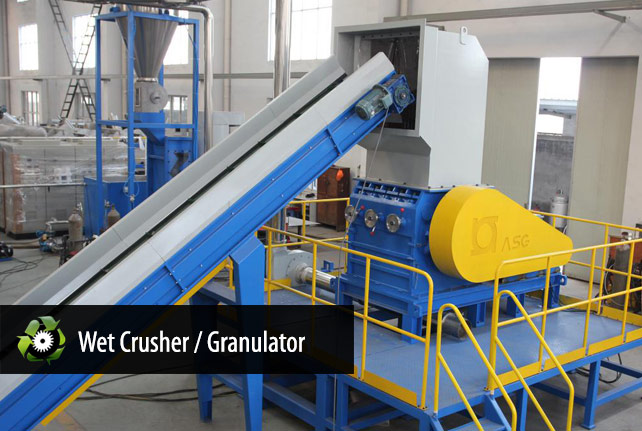
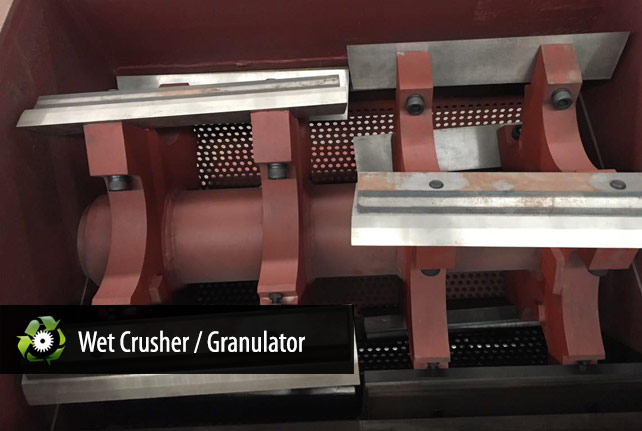
Wet Crusher /Granulator operates at much higher speeds, around 200-800 rpms. Heavy-duty knives are mounted at an angle (often times adjustable) on an open, hollow rotor in various arrays. When the blades on the fast spinning rotor makes contact with the stationary blades on the granulator housing, the feed stock is cut into relatively fine flakes or regrinds. At the bottom, or surrounding the spinning rotor is a sizing screen, a metal screen with holes the size of your desired output. The plastic film remains in the cutting chamber until it reaches the desired size, usually between several inches down to 1/8 of an inch, and falls through.
How It Works
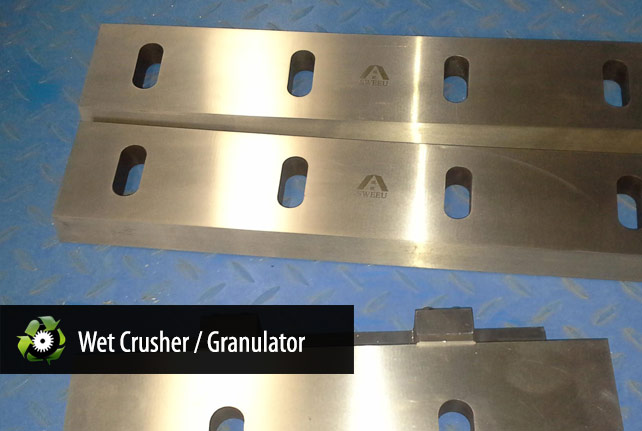
For the purpose of washing plastic film/PET bottles, most will suggest the use of a wet crusher/granulator. Wet crushers/granulators work in the same fashion except with a constant stream of water being sprayed into the cutting chamber. This setup is ideal in most plastic film and bottle washing lines because it not only accomplishes size reduction, the added water helps to initially clean or “pre-treat” dirty plastics before it reaches another set of washing equipment. The added water also acts as a lubricant for the rotating blades to reduce heat and friction, allowing the blades to last much longer before sharpening.
Although plastic granulators offer the unique ability to produce smaller sized outputs, the fast moving parts make granulators very noisy to work with and produces high amounts of dust or fines. Manufacturers of higher quality granulators often offer the option of a soundproofing outer case and methods for dust/fines reduction through the use of added screens, reduced speeds, vacuums, and wet granulation.
Models & Specifications
| Model #: | Rotor Diameter: | Knife Width: | Rotating Speed: | Motor Power: | Capacity: |
| SWP630-1000 | ⌀630mm | 1000mm | 470 rpm | 55 KW | 1000 kg/h |
| SWP630-1200 | ⌀630mm | 1200mm | 470 rpm | 55 KW | 1200 kg/h |
| SWP700-1000 | ⌀700mm | 1000mm | 470 rpm | 75 KW | 1500 kg/h |
| SWP700-1200 | ⌀700mm | 1200mm | 470 rpm | 75 KW | 1800 kg/h |
| SWP800-1000 | ⌀800mm | 1000mm | 470 rpm | 90 KW | 2000 kg/h |
| SWP800-1200 | ⌀800mm | 1200mm | 470 rpm | 90 KW | 2500 kg/h |
Additional Images
Place An Order
The general lead time for all single-piece, standard equipment orders is 30 days. For custom orders or complete washing lines, the lead time is between 60 – 90 days. The actual lead time will depend heavily on the complexity of the project as well as the amount of machinery we have in queue at the time of your order.
Contact us to discuss pricing and ordering details. Here is a brief summary of our ordering procedures.
Frequently Asked Questions
What is the difference between a wet crusher/granulator and a dry granulator?
A wet crusher/granulator sprays a constant stream of water into the cutting chamber while it operates. The water pre-cleans or “pre-treats” dirty film and bottles before they reach the main wash equipment, and it lubricates the rotating blades to reduce heat and friction, so blades last much longer between sharpening cycles. Dry granulators produce more dust and fines and run hotter, making the wet version the typical choice inside washing lines.
What materials can a wet crusher/granulator process?
It handles plastic film and PET bottles, cutting them into fine flakes or regrinds. Material stays in the cutting chamber until it passes through the sizing screen, with output typically ranging from several inches down to about 1/8 of an inch, depending on the screen hole size you select. This makes it a flexible first size-reduction step for both film and bottle washing lines.
How do I choose between the SWP630, SWP700, and SWP800 models?
Match the model to your target throughput: the SWP630 series handles 1000–1200 kg/h with a 55 kW motor, the SWP700 covers 1500–1800 kg/h at 75 kW, and the SWP800 reaches 2000–2500 kg/h at 90 kW. All run at 470 rpm with 1000 mm or 1200 mm knife widths. Confirm your facility can supply the required three-phase power, and size slightly above your average load to leave headroom.
Does the wet granulator reduce dust and noise?
The added water significantly suppresses dust and fines compared with dry granulation, and extra screens or vacuum take-off can reduce them further. Noise, however, remains a factor because of the fast-moving rotor and heavy-duty knives — many buyers add a soundproofing outer case, which higher-quality granulator manufacturers typically offer as an option, along with ear protection and enclosure planning for operators.
Where does the wet crusher/granulator fit in a washing line?
It is typically the first size-reduction step, installed after sorting or debaling and before the wash tanks. Flakes leaving the sizing screen are usually conveyed to a label and film separator and then into the washing stages. Because the water spray pre-treats the material, downstream washers receive cleaner feedstock, which improves overall line efficiency and flake quality.
What maintenance does a wet crusher/granulator require?
Inspect and sharpen the rotor and stationary blades on a regular schedule — the water spray extends intervals but does not eliminate wear. Check the sizing screen for clogging or damage, verify blade clearance, and monitor motor temperature during operation. Keep spare blade sets and screens on hand to minimize downtime, and train operators never to restart the machine under a full load of material.