

Description
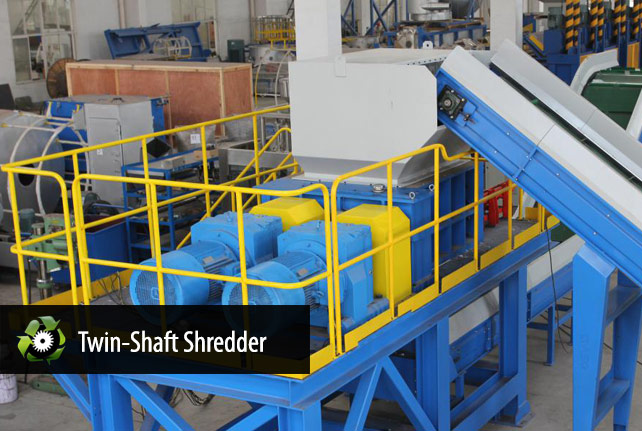
Our heavy-duty twin -shaft shredders are a perfect addition to our standard PET plastic washing line especially for washing plants requiring larger capacities. This low-speed, high-torque machine is used primarily to “pre-cut” entire bales of PET bottle plastics at volume speeds.
How It Works
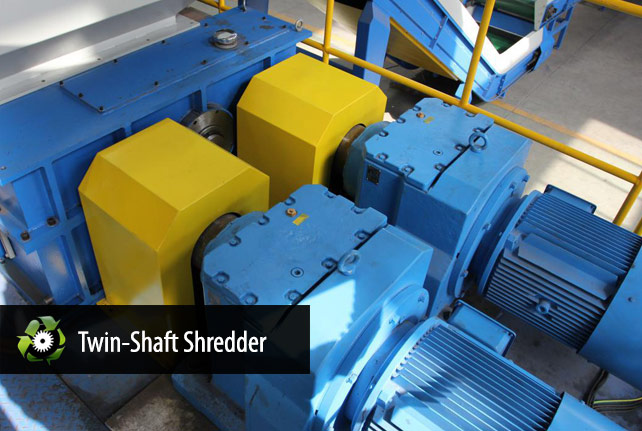
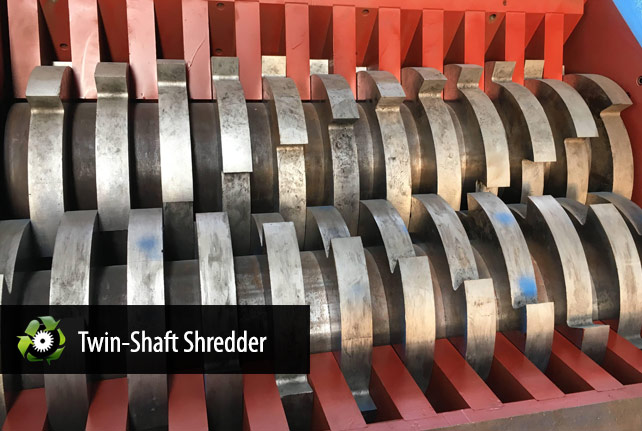
At the core of the twin-shaft shredder are shear blades mounted on 2 hexagonal shafts that rotate into each other producing a cutting /
shredding motion. These hooked styled shear blades allowing the shredder to quietly shred high volumes of PET plastic into random, smaller pieces between 1-5 inches. The low speed of the rotors also ensures that little or not dust is generated.
As our twin-shaft shredders are usually placed in front of the most demanding jobs, the frame and structure of our shredders use high-thickness sheets and tubular. The shear blades are treatment strengthened and use only the highest quality SKD11 steel (D2 equivalent) to ensure against dulling. Depending the capacity you require, we offer a variety of standard twin-shaft shredders for your choosing.
Models & Specifications
| Model #: | Motor Power: | Number of Blades: | Rotating Speed: | Capacity: |
| SSJ400-800 | 2 x 22KW | 16 / 26 | 25 / 35 RPM | 1,500 KG/H |
| SSJ400-1200 | 2 x 30KW | 24 / 40 | 25 / 35 RPM | 2,500 KG/H |
| SSJ450-800 | 2 x 30KW | 16 / 26 | 18 / 28 RPM | 3,000 KG/H |
| SSJ450-1200 | 2 x 45KW | 24 / 40 | 18 / 28 RPM | 4,000 KG/H |
Additional Images
Place An Order
The general lead time for all single-piece, standard equipment orders is 30 days. For custom orders or complete washing lines, the lead time is between 60 – 90 days. The actual lead time will depend heavily on the complexity of the project as well as the amount of machinery we have in queue at the time of your order.
Contact us to discuss pricing and ordering details. Here is a brief summary of our ordering procedures.
Frequently Asked Questions
What materials can the twin-shaft shredder process?
The shredder is designed primarily to pre-cut whole bales of PET bottle plastics at high volume. Its hooked shear blades on twin hexagonal shafts also handle other bulky plastic scrap such as drums, crates, and large molded parts, depending on configuration. Because it is a low-speed, high-torque machine, it breaks down tough, compacted material with minimal dust — ideal as the first size-reduction stage in a washing line.
How do I choose between the SSJ400-800, SSJ400-1200, SSJ450-800, and SSJ450-1200?
Select by required throughput: capacities range from 1,500 kg/h (SSJ400-800) up to 4,000 kg/h (SSJ450-1200), with dual motors from 2 × 22 kW to 2 × 45 kW and rotor speeds of 18–35 RPM. Match the shredder to your washing line’s hourly tonnage so it never starves or overloads downstream equipment, and allow headroom if you plan to expand. Larger shafts deliver higher torque for denser bales.
What is the difference between a twin-shaft and a single-shaft shredder?
Twin-shaft shredders use two counter-rotating shafts with shear blades that tear material apart at low speed and high torque, making them excellent for whole bales and bulky, unpredictable feed. Single-shaft shredders run faster against a fixed screen for more uniform output sizing. For a detailed comparison of which design suits your material and line layout, see our guide to choosing between single-shaft and double-shaft shredders.
What power supply and installation does the twin-shaft shredder need?
These are heavy machines with dual motors up to 2 × 45 kW, requiring a stable three-phase supply with proper motor protection and soft-start or VFD control. The high-thickness steel frame needs a solid, level foundation to absorb shredding forces. Allow generous clearance around the infeed hopper for loading bales by forklift or conveyor, and plan access space for blade maintenance.
How does the twin-shaft shredder integrate with a PET washing line?
It sits at the very front of the line, receiving whole bales and pre-cutting them into 1–5 inch pieces that feed evenly into the crusher or granulator downstream. This pre-shredding protects downstream equipment from oversized, compacted material and evens out material flow, which is critical for high-capacity washing plants. It connects via standard conveyors and interlocks with the line’s PET bottle recycling machine controls.
What maintenance do the shear blades require?
The shear blades are made from treatment-strengthened SKD11 tool steel (D2 equivalent) to resist dulling, but regular inspection is still essential. Check cutting edges for chips or rounding, monitor output particle size for signs of wear, and schedule resharpening or blade rotation before performance drops. Low rotor speeds keep wear rates modest, and keeping a spare blade set on hand minimizes downtime during changeovers.