

ASG Plastic Granulator Crusher
In the competitive world of plastic recycling, efficiency, durability, and output quality are paramount. ASG’s plastic granulator, often referred to as a crusher, is specifically engineered to transform whole PET plastic bottles into small, uniform pieces known as PET flakes. Integrated within a PET bottle washing line, this machine is a cornerstone for operations aiming for high purity and throughput. With advancements in wet granulation technology, ASG Machine ensures that your investment not only meets but exceeds industry standards, providing a reliable solution for recyclers, manufacturers, and international traders.
How ASG’s Plastic Granulator Enhances Your Recycling Line
ASG’s granulator employs a wet process, where a dedicated waterline continuously sprays water into the cutting chamber. This design offers two significant advantages:
- Partial Cleaning: The water aids in washing the PET flakes during the size reduction process, removing contaminants and improving material quality early in the recycling line.
- Heat and Friction Reduction: Acting as a lubricant, the water minimizes friction and heat generation within the chamber. This not only protects the integrity of the PET flakes but also substantially decreases the frequency of knife sharpening—by two to three times—leading to lower maintenance costs and less downtime.
Technical Mechanism: The Science Behind the Cut
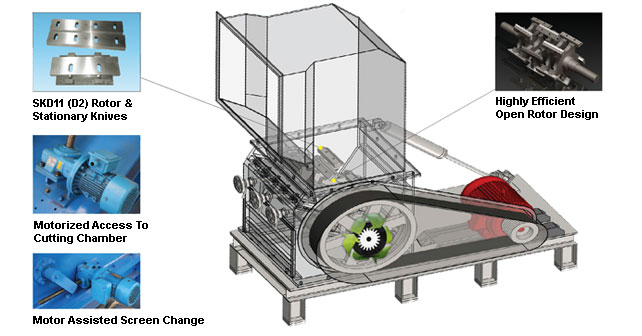
At the heart of ASG’s granulator is a robust open rotor system, equipped with knives arranged in a double-angle or v-shape configuration. Powered by a high-torque electric motor, this rotor spins at elevated speeds within a chamber fitted with stationary knives.
As PET bottles are fed into the granulator, the high-speed rotor knives interact with the stationary blades, creating a precise scissor-cutting action. This method ensures consistent and efficient size reduction. The material is continually cut until it meets the size specification and passes through a sizing screen at the chamber’s base, resulting in uniform PET flakes ready for further washing and processing.
Built for Durability: Knife Quality and Maintenance
Knife wear is a critical factor in granulator performance. ASG addresses this by using only premium SDK11 steel (equivalent to D2 steel in the U.S.) for all rotor and stationary knives. This high-carbon, high-chromium alloy offers exceptional wear resistance, extending operational periods between sharpening.
Our standard model includes 15 rotor and 4 stationary knives, all designed for easy adjustment and replacement. Hydraulic-assisted access to the cutting chamber simplifies maintenance, reducing labor time and enhancing overall productivity.
Model Specifications and Customization Options
To suit various production needs, ASG offers a range of granulator models. Each is designed with specific capacities and power requirements, ensuring there is an ideal match for your PET bottle washing line.
Below is a detailed specification table for our standard models:
| Model # | Rotor Diameter | Knife Width | Rotating Speed | Approx. Output | Motor Power |
|---|---|---|---|---|---|
| SWP630-1000 | ⌀630mm | 1000mm | 470 rpm | 1000 kg/h | 55KW |
| SWP630-1200 | ⌀630mm | 1200mm | 470 rpm | 1200 kg/h | 55KW |
| SWP700-1000 | ⌀700mm | 1000mm | 470 rpm | 1500 kg/h | 75KW |
| SWP700-1200 | ⌀700mm | 1200mm | 470 rpm | 1800 kg/h | 75KW |
| SWP800-1000 | ⌀800mm | 1000mm | 470 rpm | 2000 kg/h | 90KW |
| SWP800-1200 | ⌀800mm | 1200mm | 470 rpm | 2000 kg/h | 90KW |
For operations requiring higher output or specialized configurations, we provide custom-built granulators. Contact our engineering team to discuss your specific needs.
Industry Trends and Buyer’s Guide
The global push towards sustainability is driving demand for efficient recycling machinery. Investing in a high-quality granulator like those from ASG can significantly impact your bottom line by improving material quality, reducing energy consumption, and minimizing maintenance.
When selecting a granulator, consider: – Throughput Requirements: Match the machine’s output capacity with your production goals. – Knife Material: Opt for hardened steel knives to ensure longevity and reduce downtime. – Maintenance Features: Look for models with easy-access designs to streamline upkeep. – Integration Compatibility: Ensure the granulator seamlessly fits into your existing washing line.
ASG granulators are designed with these factors in mind, providing a future-proof solution for modern recycling facilities. For a deeper comparison of rotor types, knife materials, and throughput matching, see our guide on choosing the right PET granulator and learn how a plastic granulator shapes the entire recycling process.
Visualizing the Granulator: Additional Images
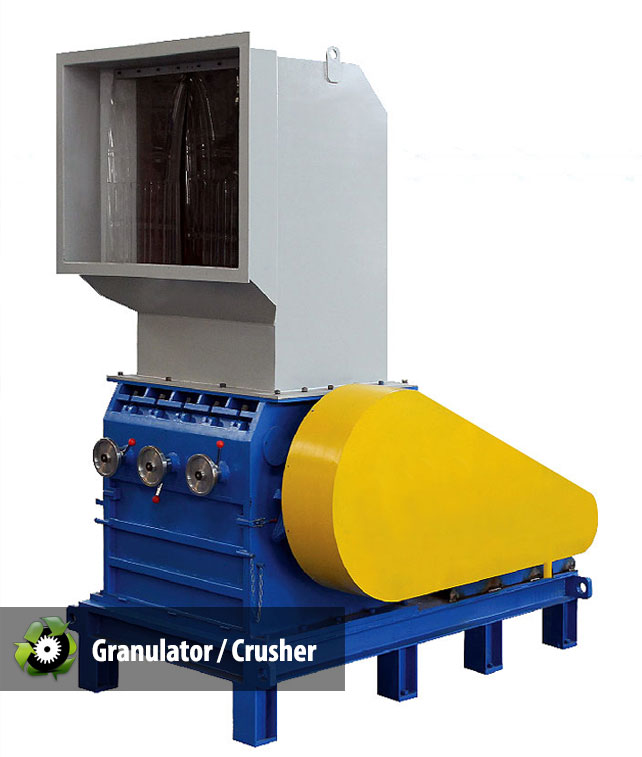
ASG Large Granulator Crusher
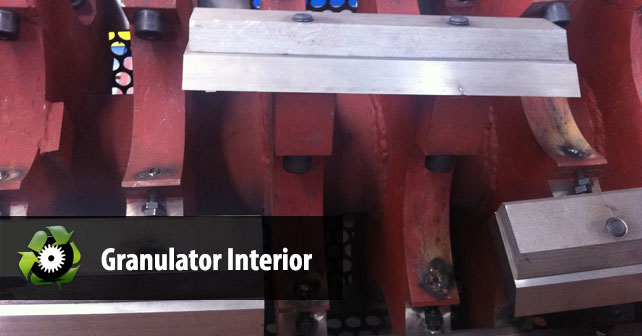
ASG Granulator Knives Interior
Frequently Asked Questions
What is the difference between a dry and a wet granulator?
Dry granulators operate without any cooling medium, which leads to higher heat generation at the cutting chamber and more frequent knife maintenance. ASG’s wet granulators continuously spray water into the chamber, cooling and lubricating the cut. This reduces friction and heat, partially washes the PET flakes during size reduction, and extends the intervals between knife sharpening by two to three times.
How often do the granulator knives need sharpening?
With ASG’s wet granulation system and premium SDK11 steel knives — the equivalent of D2 steel in the U.S. — sharpening frequency is reduced two to three times compared to dry systems. Depending on usage and material cleanliness, knives may require sharpening after several hundred hours of operation. Watch for declining flake uniformity or rising motor load as early signs that sharpening is due.
Can the granulator handle materials other than PET bottles?
While optimized for PET bottles, ASG granulators can also process other rigid plastics. Knife configuration, rotor speed, and screen size may need adjustment for different materials, so consult our engineering team before running a new feedstock. We will confirm compatibility and recommend the optimal settings to protect the knives and maintain flake quality.
What maintenance does the granulator require?
Regular maintenance includes checking knife sharpness, keeping the water spray system clean and flowing freely, and inspecting the motor and drives. Hydraulic-assisted access to the cutting chamber makes routine checks and knife adjustments straightforward, reducing labor time and keeping the machine productive with minimal downtime.
Are custom output capacities available?
Yes. Standard ASG models cover outputs from 1,000 to 2,000 kg/h with motor power from 55 to 90 kW, and we also build custom granulators for higher or unique output specifications. Share your target throughput, material type, and available power with our engineering team, and we will design a granulator sized precisely to your production needs.
How does the granulator integrate with a PET bottle washing line?
The granulator typically sits early in the washing line, after the debaler and trommel, reducing whole bottles into uniform flakes before the hot washer, friction washer, and dryers. Because wet granulation starts the cleaning process, it directly affects downstream flake purity. Match the granulator’s rated output to your line’s overall throughput so the machine never limits the washing stages that follow.
Conclusion
ASG's plastic granulator stands as a critical component in any efficient PET bottle recycling line. By integrating advanced wet granulation technology, premium materials, and user-friendly maintenance features, we deliver a machine that boosts productivity, ensures material quality, and reduces operational costs. For industry professionals seeking reliable, high-performance recycling equipment, ASG provides the engineering excellence and support needed to succeed in a competitive market.
Explore our range of models and discover how ASG Machine can enhance your recycling operations. Contact us today or visit our PET bottle washing line page to take the first step toward optimizing your production line.