

Applications
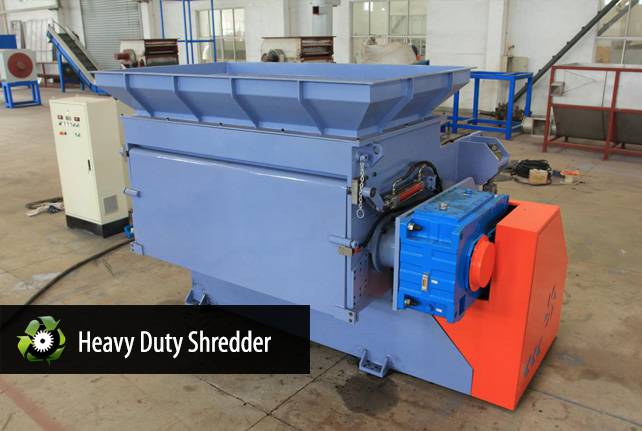
This shredder can process a wide range of materials including rubber blocks, cables, waste plastics, etc…
How it works
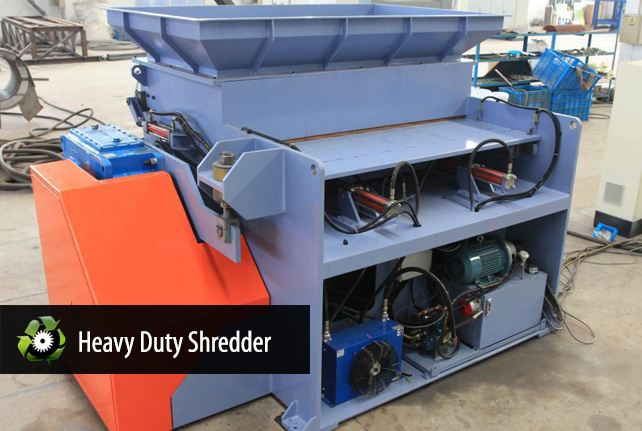
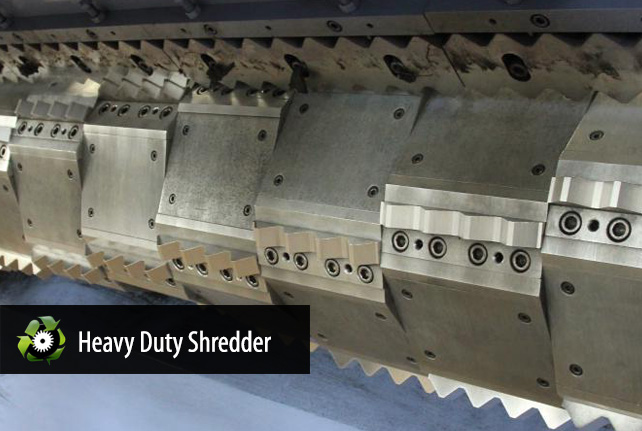
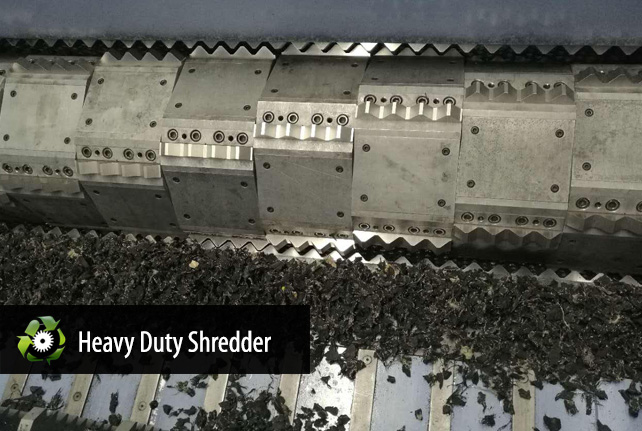
Our shredders use unique, three-teeth knives that are bolted securely onto a large, closed rotor in a staggered array. As the three-teeth rotor knives are mounted with the corners protruding, jagged-teeth knives are mounted within the cutting chamber that act as the stationary knives. As material is fed into the shredder, a hydraulic assisted drawer pushes the material against the rotor where it will be continuously cut until it reaches the desired size as designated by a screen filter that is fitted beneath the cutting chamber; The material will continue to be shredded until it is small enough to fall through this screen filter.
As our shredders are often times placed in front of the most demanding jobs, the frame and structure of our shredders use high-thickness sheets and tubular. The square knives are treatment strengthened and use only the highest quality SKD11 steel (D2 equivalent) to ensure against dulling. Depending the capacity you require, we offer a variety of standard heavy-duty shredders for your choosing.
Features
- Highly resistant hooks – high resistance to wear, may be welded again, optimized shredding geometry
- Housing in two parts – easy and quick exchange of the whole shafts possible by simple unscrewing of the superior element of the housing
- High sealing for bearings – quadruple sealing preventing leakages, even for liquids
- Shock absorbers – efficient protection system of the hydraulic drive against overloads
- Hydraulic drive – special design hydraulic drive for optimal torque and performance, works perfectly in extreme conditions
Specifications
| Model # | Motor Power | Shaft Diameter | Rotary Speed | Capacity |
| SSJ-1000 | 45KW | ⌀450mm | 55 rpm | 1000 kg/h |
| DS2000 | 110KW | ⌀500mm | 45 rpm | 3000 kg/h |
| DS3000 | 2*110KW | ⌀500mm | 40 rpm | 5000 kg/h |
Additional Images
Place an Order
The general lead time for all single-piece, standard equipment orders is 30 days. For custom orders or complete washing lines, the lead time is between 60 – 90 days. The actual lead time will depend heavily on the complexity of the project as well as the amount of machinery we have in queue at the time of your order.
Contact us to discuss pricing and ordering details. Here is a brief summary of our ordering procedures.
Frequently Asked Questions
What materials can the heavy-duty shredder process?
This shredder handles rubber blocks, cables, waste plastics, tires, and other tough, bulky scrap. Its three-teeth rotor knives and jagged stationary knives tear through elastic and fibrous materials that jam ordinary granulators, while a hydraulic-assisted drawer keeps feeding force steady. The staggered knife array and high-thickness steel frame are built specifically for the most demanding, high-abrasion jobs in a recycling plant.
How do I choose between the SSJ-1000, DS2000, and DS3000 models?
Choose by throughput and material toughness: the SSJ-1000 processes about 1,000 kg/h with a 45 kW motor, the DS2000 reaches 3,000 kg/h with 110 kW, and the DS3000 tops 5,000 kg/h with dual 110 kW drives. Larger shaft diameters (Ø450–Ø500 mm) and slower rotor speeds deliver the torque needed for dense rubber and tire stock. Size the machine to your peak hourly volume with room for growth.
How does the cutting and sizing system work?
Three-teeth knives bolted to a large closed rotor cut against jagged stationary knives in the cutting chamber. A hydraulic-assisted drawer pushes material against the rotor, and shredding continues until particles are small enough to fall through the screen filter fitted beneath the chamber. Swapping the screen changes the output size — finer screens for granulator feed, coarser screens for volume reduction.
What power supply and installation does the shredder need?
Motor power ranges from 45 kW up to 2 × 110 kW on the largest model, so a robust three-phase supply with proper protection and soft-start control is essential. The hydraulic drive needs clean hydraulic fluid and periodic checks. Install on a solid, level foundation with vibration control, and allow clearance for the drawer mechanism, screen changes, and blade access during maintenance.
Should I choose this shredder or a twin-shaft design?
This heavy-duty single-rotor design with a hydraulic drawer and screen excels at controlled, uniform output sizing for rubber, cable, and tire scrap. Twin-shaft shear shredders are better for tearing whole bales and unpredictable bulky feed at low speed. For help matching the rotor design to your material stream, see our guide to choosing between single-shaft and double-shaft shredders.
What maintenance does the heavy-duty shredder require?
Routine maintenance centers on the SKD11 tool-steel knives: inspect for chips and dulling, resharpen or rotate them on schedule, and check screen condition. The hydraulic drive needs fluid-level and seal checks, while the quadruple-sealed bearings and shock absorbers should be inspected for wear. The two-part housing design allows quick shaft exchange, and keeping spare knives and screens on hand minimizes downtime.