

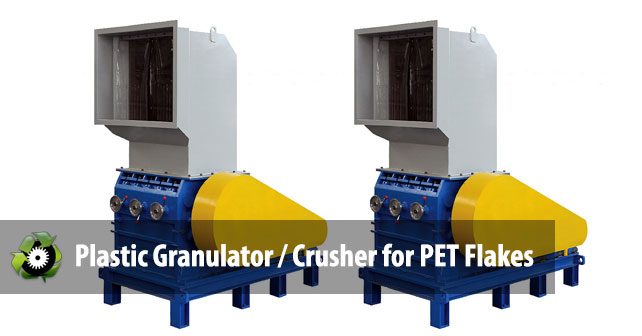
When looking to optimize a PET bottle washing line, the first piece of equipment to look into is usually the plastic granulator or sometimes referred to as “crusher”. A properly designed and maintained plastic granulator for cutting PET bottles into PET flakes will not only optimize material quality, but also production efficiency and throughput.
How Plastic Granulators Work
A plastic granulator contains two sets of cutting knives located within the cutting chamber. One set is fixed and is known as the “bed knives”. The other set of knives is mounted on a spinning “open” rotor known as the “rotor knives”. As the rotor is spun rapidly by an electric motor, the rotor knives come into contact with the bed knives creating a “scissor cutting” motion.
As with ASG’s plastic granulators and general consensus by PET recycler’s world-wide, rotor knives arranged in this “double-scissor” array offers optimal cutting. Our open rotor design accompanied with 10 rotor knives and 4 bed knives offers the highest efficiency and durability for cutting PET bottles into PET flakes (either flattened or non-flattened).
*note: flattened bottles will have higher output rates.
At the bottom of the cutting chamber is metal screen with many holes of a specific size. In our PET recycling lines, we recommend the holes to be approximately 95mm in diameter. The PET bottles will continue to be cut within the cutting chamber until the PET flakes are small enough to fall through, usually between 12-18mm.
Directly after the granulation process, a blower is used to send the PET flakes into a air classification system where fines and light weight plastics (such as PP/PE films from bottle labels) are filtered and collected.
Granulator Maintenance Best Practices
In this section, we cover some of the best maintenance practices you should adhere to when running your PET washing plant. While it may seem troublesome at first, a well maintained granulator can greatly increase the quality of your PET flakes (equals to higher sell prices) as well as the material throughput.
- The best advice we can give is to keep the knives sharpened. Sharp knives will increase throughput by increasing bulk density, lower the amount of fines, and offer the highest quality PET flakes. Plus, PET flakes produced with dull knives will have inconsistent or split edges. This will causes lower outputs in the float/sink separation tanks as the “open” edges will trap air bubbles making the PET flakes float along with the PP/PE films.
- The gap between the bed and rotor knives needs to be properly checked and maintained. This will play a part in keeping the knives sharp.
- Based on the sound and quality of PET flakes produced, a trained operator will know if the granulator requires maintenance. Don’t wait for operators to tell you, create a schedule of regular and preventative maintenance.
- An efficient PET recycling plant is always prepared with several sets of sharpened granulator knives. Once a change is required, the extra sets are used. The dull sets are sent for sharpening without interfering with operations.
- A clogged screen means PET flakes are not falling through properly which causes the backup of PET flakes into the cutting chamber. This leads to excess heat build-up within the cutting chamber enough to melt the PET flakes which induces further clogging. Ideally, check the screen filter at the end of each session and brush it with a metal, wire brush
- This is a general tip, make sure to keep an inventory of spare parts such as additional knives, screens, belts, etc. This will help facilitate “in-plant” repairs and lower downtimes.
- Try to keep equipment maintenance during “off shifts”.
- Never turn off the granulator with PET bottles/flakes still inside (unless it is an emergency). As there will be many “un-granulated” PET flakes still within the cutting chamber, turning the granulator on again with an impeded rotor may cause electric failure. In the case of emergency, make sure to clean out the cutting chamber before turning the granulator on again.
- Lastly, a properly documented flow including the marking and labeling of finished products (mark the box/bag) is essential. This will be extremely useful with problems arise. Create lot numbers to you can track where the PET bottles came, which operators produced the PET flakes, the date, tare/weights, PVC content, as well as the set of equipment used.
Safety Considerations
As with all recycling facilities, equipment safety should be a major concern. Below are some safety tips to consider with operating your PET washing plant:
- All conveyors, granulators, and washing/drying equipment should be equipped with its own emergency shut-off switches.
- Make sure proper training is given to all operators.
- To keep the noise level of granulation equipment to the minimum, soundproofing with an outer case should be implemented to keep noise exposure below regulatory limits.
- Make sure to have proper ventilation or dust collection for cyclones, blowers, and dryers throughout the PET bottle washing line.
Conclusion
While this is in no way an operations manual for our granulators, we hope to offer some tips and tricks to ensure a smooth operating PET bottle washing plant. This is especially true for new operators and those new to the business. While our PET washing lines are fully automatic, experienced operators as well as a clear plan for maintenance should be present to ensure your recycling plant runs smoothly year and year.
As customer service is very important for ASG Recycling, we hope your relationship with us does not end after the purchase of our equipment. Instead, let’s work together to increase your recycling capacity.
Frequently Asked Questions
What screen size should I use for PET flake production?
For PET recycling lines, a screen with holes of approximately 95 mm in diameter is recommended. Bottles continue to be cut inside the chamber until the flakes are small enough to fall through, generally producing flakes in the 12–18 mm range — the ideal size for washing, label separation, and sink/float separation downstream.
Why do sharp knives matter so much for PET flake quality?
Sharp knives increase throughput by improving bulk density, reduce fines, and produce clean, consistent flake edges that command higher sell prices. Dull knives create inconsistent or split edges; the “open” edges trap air bubbles, which makes PET flakes float along with PP/PE label films in the sink/float separation tanks and lowers separation efficiency.
Do flattened bottles process differently than non-flattened bottles?
Yes — flattened bottles feed through the granulator more easily and achieve higher output rates than whole, non-flattened bottles. If your incoming bales contain a high share of unflattened bottles, expect somewhat lower throughput from the same machine, and factor that into your line capacity planning.
What happens if the granulator screen clogs?
A clogged screen stops flakes from falling through, causing material to back up into the cutting chamber. The resulting friction creates excess heat — enough to melt PET flakes — which induces further clogging and can damage the machine. Check the screen at the end of each session and brush it clean with a metal wire brush.
How should I maintain granulator knives and screens?
Keep knives sharp with a preventive sharpening schedule rather than waiting for operators to report problems, and keep several pre-sharpened sets ready so dull sets can be swapped out without stopping production. Maintain the correct gap between bed and rotor knives, stock spare knives, screens, and belts, and schedule maintenance during off shifts whenever possible.
Can I turn off the granulator with material still inside?
Never — unless it is an emergency. Un-granulated bottles and flakes left in the cutting chamber impede the rotor, and restarting under load can cause electrical failure. In an emergency shutdown, always clean out the cutting chamber completely before turning the granulator back on.