

Description
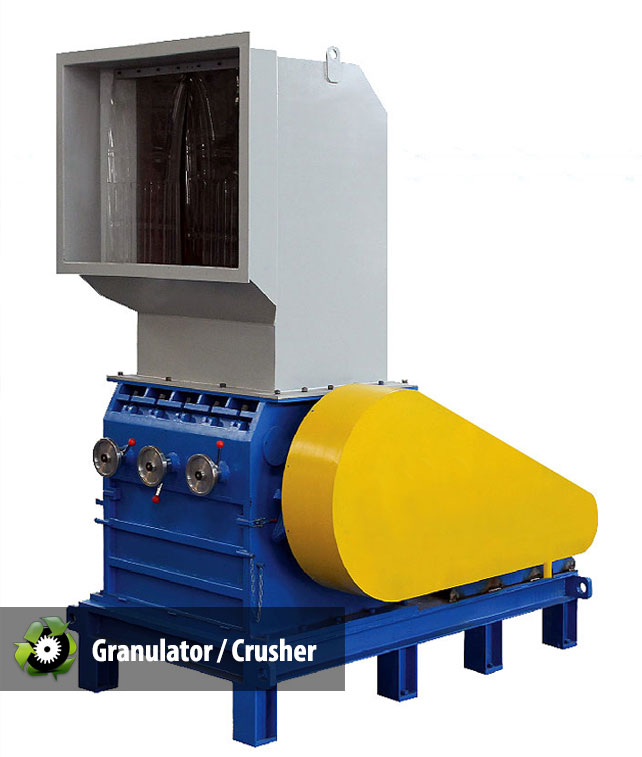
ASG’s plastic granulator, sometimes referred to as a “crusher”, cuts whole PET plastic bottles into small, uniform pieces, or more popularly known as PET flakes.
Within our PET bottle recycling line, a wet granulator is actually used where an added waterline is implemented to continuously spray water into the cutting chamber. This feature has two important uses:
- The PET flakes are partially cleaned within the wet granulator.
- The water acts as a lubricate lowering friction and heat within the cutting chamber. By adding water to the cutting chamber, we can decrease the frequency of knife sharpening by two to three times.
How It Works
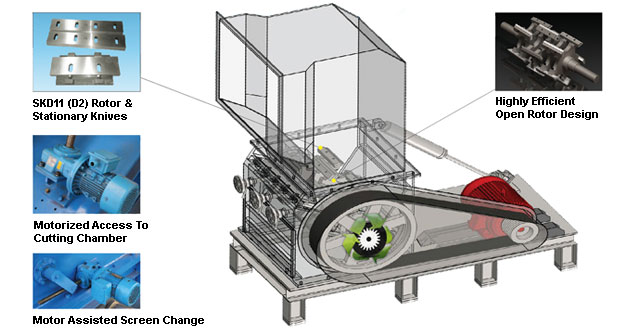
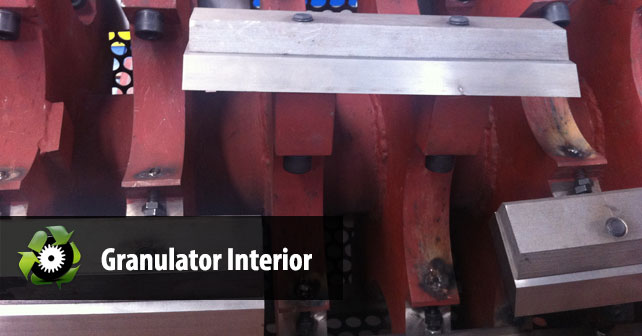
To explain briefly how granulators work, at the core of this robust cutting machine is an open rotor knives mounted with knives in either a double-angle or v-shape array. This rotor, spun by a powerful electric motor, spins at high speeds within a cutting chamber where stationary knives are mounted.
As the PET bottles enter the cutting chamber, the spinning rotor knives come into contact with the stationary knives creating a “scissor cutting” motion. As the rotor continues to spin, the PET bottles are cut into smaller and smaller pieces until they fall through a sizing screen located at the bottom of the cutting chamber.
Models & Specifications
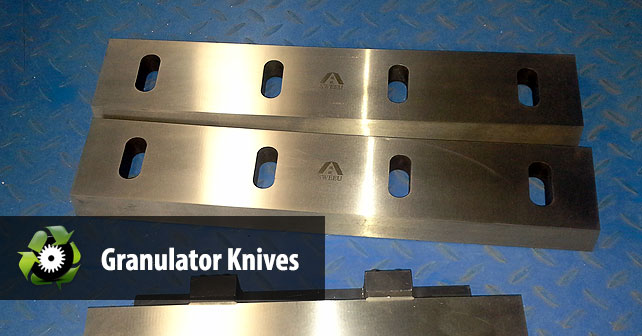
Our standard wet granulator houses 15 rotor and 4 stationary knives. As wear and tear on the knives is extremely high, it is crucial to use only the highest quality knives available on the market today; Hence, all ASG granulator knives are made from SDK11 (equivalent to D2 in the United States) high-carbon, high-chromium steel which ensures longest usage times before requiring sharpening. In addition, all knives are easily adjustable with hydraulic assisted access to the cutting chamber which makes the exchange or sharpening of knives easy and less time consuming.
We offer a variety of granulator models for you to choose from depending on the specifications on capacity in your PET bottle washing line. Below are specifications of our standard granulators.
| Model # | Rotor Diameter | Knife Width | Rotating Speed | Approx. Output | Motor Power |
| SWP630-1000 | ⌀630mm | 1000mm | 470 rpm | 1000 kg/h | 55KW |
| SWP630-1200 | ⌀630mm | 1200mm | 470 rpm | 1200 kg/h | 55KW |
| SWP700-1000 | ⌀700mm | 1000mm | 470 rpm | 1500 kg/h | 75KW |
| SWP700-1200 | ⌀700mm | 1200mm | 470 rpm | 1800 kg/h | 75KW |
| SWP800-1000 | ⌀800mm | 1000mm | 470 rpm | 2000 kg/h | 90KW |
| SWP800-1200 | ⌀800mm | 1200mm | 470 rpm | 2000 kg/h | 90KW |
*Larger, more powerful granulators are available based on your request.
Additional Images
Place an Order
The general lead time for all single-piece, standard equipment orders is 30 days. For custom orders or complete washing lines, the lead time is between 60 – 90 days. The actual lead time will depend heavily on the complexity of the project as well as the amount of machinery we have in queue at the time of your order.
Contact us to discuss pricing and ordering details. Here is a brief summary of our ordering procedures.
Frequently Asked Questions
Should I choose a wet or dry granulator for PET bottles?
For PET bottle recycling, a wet granulator is usually the better fit. The continuous water spray partially cleans flakes, cools the cutting chamber, and — by lowering friction and heat — cuts knife-sharpening frequency by two to three times. A dry granulator suits clean, pre-sorted feed where water handling is unwanted, but most washing lines run wet because the cleaning benefit comes free with size reduction.
How do I choose the right SWP model for my line?
Match the granulator’s approximate output to your washing line capacity: SWP630 models handle around 1,000–1,200 kg/h, SWP700 covers 1,500–1,800 kg/h, and SWP800 reaches about 2,000 kg/h. Size for peak feed rather than average, and leave headroom for surge. Confirm your electrical supply supports the 55–90 kW motor range before selecting.
How long do the granulator knives last?
ASG uses SDK11 (equivalent to D2) high-carbon, high-chromium steel knives — 15 rotor and 4 stationary in the standard wet granulator — because knife wear is the highest running cost. Water cooling extends intervals between sharpening significantly. Knives are adjustable and the cutting chamber opens with hydraulic assistance, so exchange or sharpening is fast and less labor-intensive.
What are the power and installation requirements?
Depending on the model, plan for 55–90 kW of three-phase power with appropriately rated breakers and cabling. The wet version also needs a reliable water supply and drainage for the spray system; a recirculation tank keeps consumption reasonable. Allow clearance around the housing for screen changes and hydraulic-assisted knife access, and route discharge into your washing stage.
What flake size does the granulator produce?
Output size is set by the sizing screen at the bottom of the cutting chamber: bottles are cut smaller and smaller until pieces fall through. Screen aperture can be selected to suit your downstream washing and extrusion equipment. Uniform flakes wash and dry more evenly, so choose the screen together with the rest of the line rather than in isolation.
Where does the granulator fit in the PET recycling line?
It follows the debaler and pre-washer: whole bottles are cut into flakes that then flow through hot washing, friction washing, rinsing, and centrifugal drying before pelletizing. Because flake quality and size consistency affect every downstream stage, the granulator is one of the highest-leverage machines in the line — specify it together with the washing equipment.