

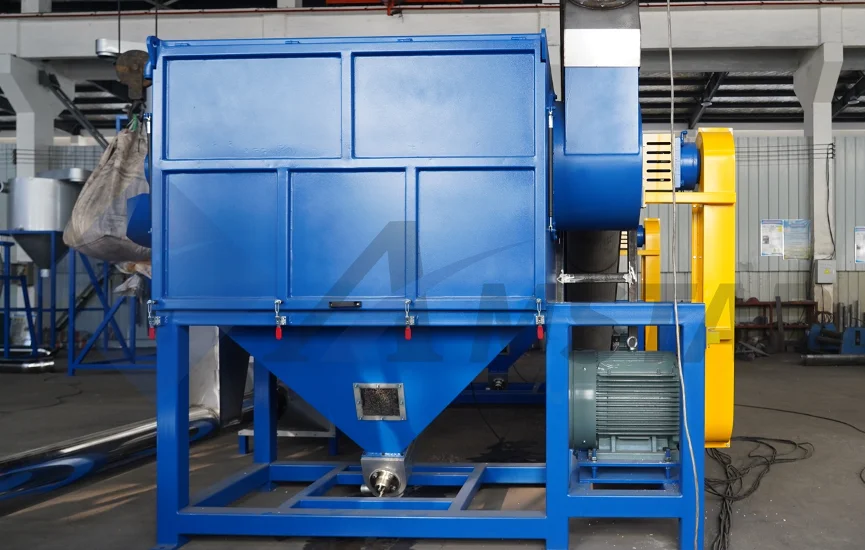
Efficient Moisture Removal for Flakes, Films & Pellets
When it comes to plastic recycling, moisture is the biggest challenge after washing.
Wet flakes or pellets can cause blockages, poor extrusion, or uneven pelletizing.
A high-speed centrifugal dryer (also known as a plastic dewatering machine) offers the most efficient solution — removing up to 95–98% of surface water within seconds, before the material enters a thermal dryer or extruder.
How the Centrifugal Dryer Works
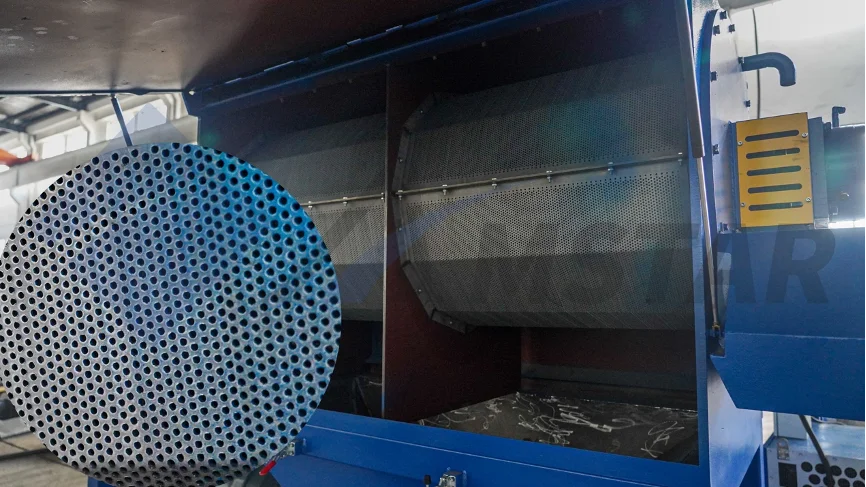
| Step | Process | Description |
| 1. Feeding | Wet flakes enter through a hopper or screw conveyor. | Material is evenly distributed into the spinning chamber. |
| 2. Spinning & Separation | High-speed rotation (up to 1,200 rpm). | Centrifugal force drives water through perforated screens. |
| 3. Discharge & Collection | Dry flakes exit from the top outlet. | Water drains away through the bottom channel and can be recycled. |
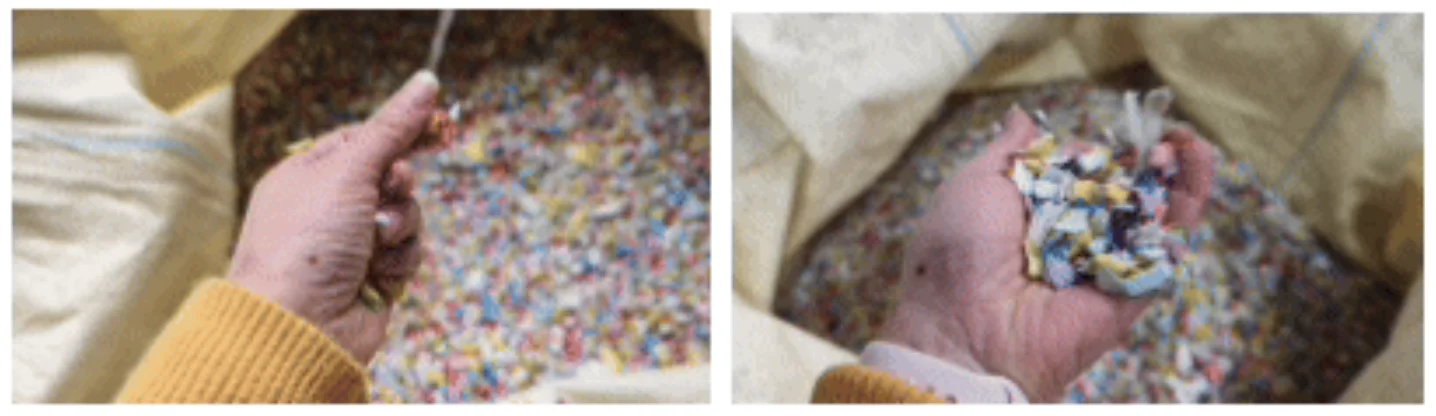
Result: Clean, dry flakes — ready for thermal drying, extrusion, or pelletizing.
Applications in Plastic Recycling / Reprocessing
Centrifugal dryers are widely used in plastics recycling and pelletizing because they offer fast dewatering with low thermal stress. Typical use cases include:
- Washing line after cleaning: After sink-float, friction washing, or hot washing stages, wet flakes can be dried by centrifugation before entering dryers or extruders.
- Pelletizing lines: Immediately after underwater pelletizer or cut-strand extruder, melt-cut pellets may carry water; a centrifugal dryer helps reduce surface moisture before further drying or storage.
- Flakes / PET bottle recycling: Removing physical water from PET flakes or mixed plastic flakes.
- Film / sheet recycling: For washed film / sheet pieces, centrifugal drying can reduce water without applying heat, reducing chance of sticking or distortion.
- Mixed plastic streams: When different plastic types are processed together, centrifugal drying is a non-thermal method less likely to degrade sensitive polymers.
- High-throughput lines: Because centrifugal dryers can process high volumes per hour (depending on size, rotor speed), they are suitable for industrial-scale recycling plants.
Advantages of Using a Centrifugal Dryer
Compared with traditional thermal drying methods, centrifugal dryers offer multiple operational and environmental benefits:
- ✅ Energy-saving: Uses mechanical energy instead of heat, reducing power consumption by up to 50%.
- ✅ Fast drying: Achieves 90–95% water removal in seconds.
- ✅ Low temperature: Protects heat-sensitive plastics from deformation.
- ✅ Compact footprint: Ideal for modular washing lines.
- ✅ Low maintenance: Fewer moving parts and minimal dust generation.
- ✅ Environmentally friendly: Recycles water, lowers carbon footprint.
These advantages make centrifugal dryers the preferred choice for PET bottle flakes, HDPE containers, PP woven bags, film scraps, and pelletized plastics.
Limitations / Challenges
- Not suitable for extremely fine powders (very small particles may pass through screens or not effectively dewater)
- Material carryover / losses: small granules may be lost if screen design is poor
- Vibration & mechanical stress: high rotational speeds demand precise balancing and structural rigidity
- Maintenance: screens can clog, bearings wear, sealing challenges
- Initial cost: well-built designs with robust parts may have higher capex
- Residual moisture floor: may not reduce moisture to as low as full thermal dryers in some cases
Why Choose ASG
With over 20 years of experience in plastic recycling machinery manufacturing, ASG is recognized for engineering efficient, durable, and fully integrated recycling systems.
Here’s why thousands of recyclers worldwide choose ASG:
- Proven expertise: Over two decades of hands-on experience in PET, HDPE, and PP recycling solutions.
- Complete systems: From washing lines and friction washers to centrifugal dryers and pelletizing lines.
- Quality components: Siemens / WEG motors, NSK / SKF bearings, heavy-duty stainless steel construction.
- Precision manufacturing: Designed for high efficiency, reliability, and low vibration.
- 24-hour global support: Fast response and comprehensive after-sales service.
Conclusion
A centrifugal dryer is not just a drying unit — it’s the key to a clean, stable, and efficient recycling process.
By combining mechanical speed with smart engineering, ASG’s dryers deliver high output, low energy use, and consistent results that keep your recycling line running smoothly every day.
Contact us today for a customized solution built for your specific materials and capacity.
👉 Explore More:
- High Speed Centrifugal Dryer — Fast, Efficient Drying for Plastic Recycling
- Centrifugal dryer for rapid drying for plastic recycling facilities In Washington, USA
- High-Speed Centrifugal Dryer – A Efficient Drying Solution
INQUIRIES
To learn more about this product, please send us a message using the form below:
Frequently Asked Questions
How dry does material get in a centrifugal dryer?
A well-set centrifugal dryer removes roughly 95–98% of surface water within seconds of spinning at up to 1,200 rpm. That leaves flakes or pellets with only a few percent residual moisture — dry enough for many pelletizing lines, though food-grade or low-moisture applications typically add a thermal dryer afterwards to reach under 1%. Actual results depend on material shape, screen condition, and feed rate.
Can a centrifugal dryer handle washed film without it sticking?
Yes — that is one of its strengths. Because dewatering is purely mechanical, film and sheet pieces dry without the heat that causes sticking or distortion in thermal dryers. Even feed distribution into the spinning chamber matters most: clumped film dewaters unevenly, so a screw conveyor or even infeed keeps results consistent.
How do I size a centrifugal dryer for my line?
Size it to your washing line’s peak wet throughput, since the dryer must swallow everything the washers discharge without backing up. Rotor diameter, chamber length, and speed (up to 1,200 rpm) set capacity — confirm the rated kg/h against your line before ordering. An undersized dryer becomes the bottleneck; an oversized one just costs more capex.
What maintenance do the bearings and screens need?
Bearings are the critical wear point at high rotational speeds: keep them lubricated per schedule, watch for vibration or temperature rise that signals wear, and replace with quality equivalents (the design uses NSK/SKF-grade bearings). Screens can clog with fines, so inspect and clean them regularly — poor screen condition also increases material carryover losses.
What are the power and installation requirements?
Centrifugal dryers use mechanical energy instead of heat, cutting power consumption by up to 50% versus thermal drying. Still, plan three-phase power for the high-speed motor and a rigid, level foundation — 1,200 rpm demands precise balancing and structural rigidity to control vibration. Provide drainage for the separated water, which can be recycled back to the washing stage.
Where does the centrifugal dryer sit in the recycling line?
It goes immediately after washing — sink-float, friction, or hot wash — and before thermal drying, extrusion, or pelletizing. In pelletizing lines it also works right after the underwater pelletizer or strand cutter to strip surface water from fresh pellets. Placing it first in the drying sequence slashes the energy the thermal dryer must supply.