

Description
The first stage in the drying process in our standard PET bottle washing line, the high speed dewatering machine has the unique ability to remove a large portion of water content within the PET flakes directly after the washing process. To accomplish this, centrifugal force is used to spin water outwards while the PET flakes are contained within.
How It Works
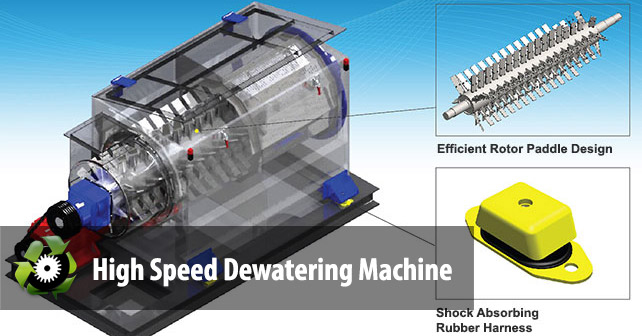
This horizontal centrifuge is very similar in structure to our high speed friction washer. At the core of both machines is a long shaft mounted with many panels or paddles spun by an electric motor. Surrounding the paddled shaft is a mesh screen tunnel. The entire apparatus is then encased in a metal container.
As the slurry PET flakes are fed into the vertical feeder, the spinning shaft that spins at nearly 1,000 rotations per minute continuously thrown the PET flakes outwards against the mesh screen tunnel. Water passes through the mesh screen and is collected for recycling while the PET flakes are contained within. The PET flakes, now partially dried, moves onto the next drying equipment, usually a thermal dryer. Generally, ASG’s dewatering machine will lower the PET flake’s moisture content to roughly 15-20%.
Models & Specifications
| Model #: | Motor Power: | Main Shaft Diameter: | Rotating Speed: | Capacity: |
| HXJ400 | 37KW | 400mm | 1400 RPM | 400 – 800 KG/H |
| HXJ550 | 45KW | 550mm | 1200 RPM | 600 – 1000 KG/H |
| HXJ750 | 55KW | 750mm | 1080 RPM | 1200 – 2000 KG/H |
Additional Images
Place An Order
The general lead time for all single-piece, standard equipment orders is 30 days. For custom orders or complete washing lines, the lead time is between 60 – 90 days. The actual lead time will depend heavily on the complexity of the project as well as the amount of machinery we have in queue at the time of your order.
Contact us to discuss pricing and ordering details. Here is a brief summary of our ordering procedures.
Frequently Asked Questions
How dry do PET flakes get after the dewatering machine?
ASG’s dewatering machine lowers PET flake moisture content to roughly 15–20%. It is the first stage of drying — the partially dried flakes then move on to a thermal dryer for final drying. This two-stage approach is more energy efficient than trying to reach final dryness with heat alone, since mechanical dewatering removes the bulk of the water first.
How does the high-speed dewatering machine work?
It is a horizontal centrifuge. Flakes enter through a vertical feeder while a paddled shaft spins at nearly 1,000 rotations per minute, throwing the PET flakes outward against a mesh screen tunnel. Water passes through the screen and is collected for recycling, while the flakes stay contained inside and discharge partially dried toward the next drying stage.
Which model matches my line capacity?
Three models are available: the HXJ400 handles 400 – 800 KG/H, the HXJ550 handles 600 – 1,000 KG/H, and the HXJ750 handles 1,200 – 2,000 KG/H. Choose the model whose range covers your washing line throughput with some headroom — running a dewatering unit at its upper limit leaves no margin for surges in feed rate.
Can the dewatering machine process materials other than PET?
The machine is designed around PET flakes from bottle washing lines, where particle size and bulk behavior are well understood. Whether it suits another plastic depends on flake size, density, and how the material behaves under centrifugal force. Share your material details with our engineering team and we will confirm suitability before you order.
What maintenance does a dewatering machine need?
Focus on the wear components: inspect the mesh screen tunnel for damage or blinding, check the paddles and shaft for wear, and monitor bearings and drive parts for noise or vibration. Because the shaft spins at nearly 1,000 RPM, keeping the machine balanced and the screen intact is essential for reliable, continuous operation.
What is the lead time for a dewatering machine?
Standard single-piece equipment orders generally ship in about 30 days. Custom configurations or complete washing lines take 60 – 90 days depending on project complexity and the current manufacturing queue. Contact us with your target capacity and timeline for a confirmed delivery schedule.