

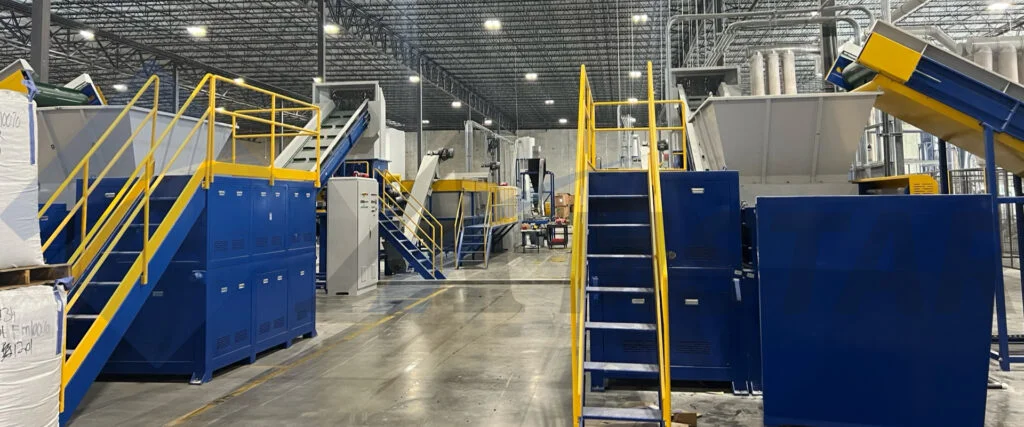
This 1000KG/H PP PE Film Washing Pelletizing Line is designed for efficient recycling of post-industrial and post-consumer plastic films such as PP woven bags, PE agricultural film, LDPE packaging film, and stretch film.
Optimized specifically for light, flexible film materials, this system integrates shredding, washing, dewatering, densifying, and pelletizing into one continuous production line.
It is an ideal solution for recycling plants seeking stable output, low moisture content, and high-qualityrecycled pellets suitable for extrusion or injection molding applications.
System Overview
The complete line consists of two main sections:
- PP PE Film Shredding & Washing Line – for size reduction, deep cleaning, and moisture removal
- Pelletizing Line – for melt filtration, extrusion, and pellet production
Designed Capacity: 1000 kg/h
Applicable Materials: PP / LDPE / LLDPE / HDPE film
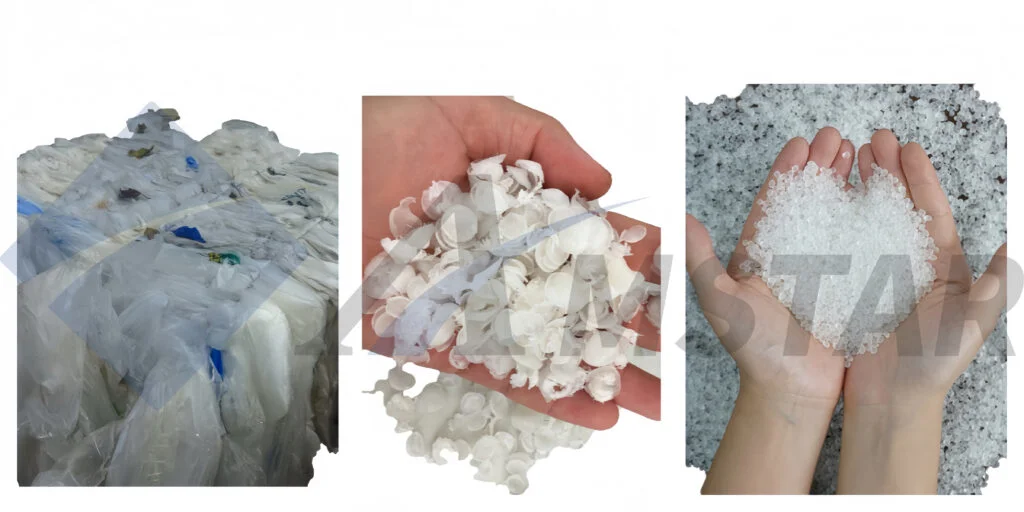
Final Product: Clean, uniform plastic pellets
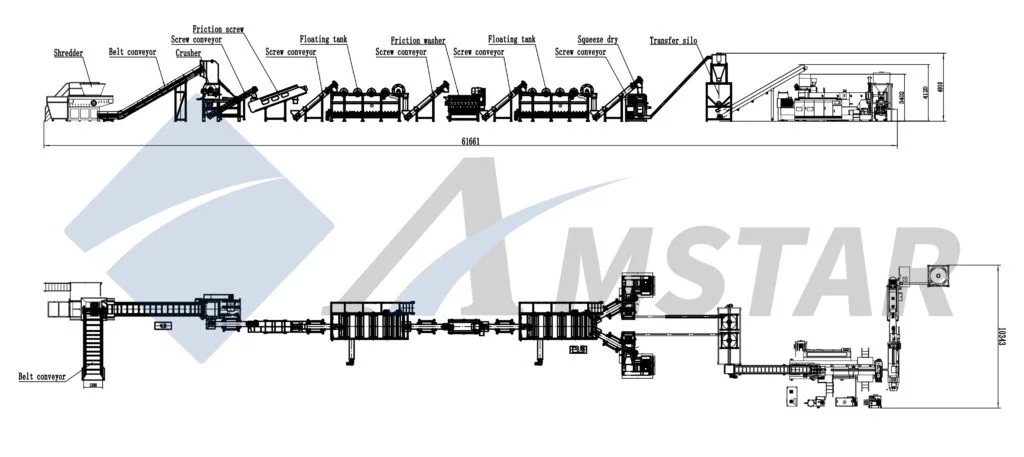
1. PP PE Film Shredding & Washing Line
This section focuses on removing dirt, sand, organic contamination, and residual moisture while maintaining material integrity.
Equipment Configuration
| No. | Equipment Name | Model | Function |
| 1 | Rubber Belt Conveyor | PSL-1600 | Uniform feeding of film material |
| 2 | Single Shaft Shredder | DSL-1600 | Heavy-duty size reduction |
| 3 | Belt Conveyor (Magnetic) | PS-1000 | Metal removal & transfer |
| 4 | Wet Granulator | SWHB-1200 | Cutting + pre-washing |
| 5 | Screw Conveyor | LX-356 | Material transfer |
| 6 | Friction Screw | LX-630 | Surface dirt removal |
| 7 | Floating Tank (1st) | QXC-1700 | Separation of contaminants |
| 8 | Friction Washer | HXJB-950 | Intensive washing |
| 9 | Floating Tank (2nd) | QXC-1700 | Final cleaning & separation |
| 10 | Screw Conveyors | LX-356 | Continuous transport |
| 11 | Squeezer (Dewatering) | JGJ-320 | Moisture reduction & densifying |
| 12 | Transit Silo | — | Buffer storage |
| 13 | Electrical Control System | — | Centralized control |
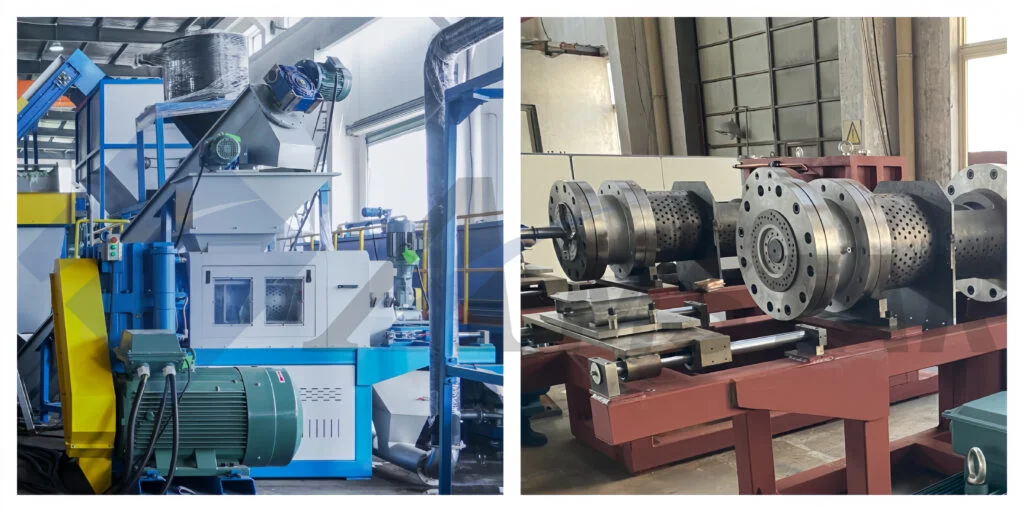
Key Washing Advantages
- Multi-stage washing for high cleanliness
- Floating tanks remove sand, labels, and heavy impurities
- High-speed friction washing improves surface purity
- Squeezer reduces moisture content to below 3–5%
- Optimized water and energy consumption
2. PP PE Film Pelletizing Line
After washing and densifying, the clean film flakes are converted into high-quality pellets through stable extrusion and filtration.
Pelletizing Line Configuration
| No. | Equipment Name | Model | Key Features |
| 1 | Feeding Conveyor | — | Controlled material feeding |
| 2 | Single Screw Extruder | SJ180/28 | High torque, stable melting |
| 3 | Hydraulic Screen Changer | — | Continuous filtration |
| 4 | Secondary Extruder | SJ200/10 | Pressure stabilization |
| 5 | Screen Changing System | — | Fast screen change (<2s) |
| 6 | Water Ring Pelletizer | — | Uniform pellet cutting |
| 7 | Centrifugal Dryer | — | Pellet dewatering |
| 8 | Storage Hopper | — | Finished pellet storage |
| 9 | Control Cabinet | — | Temperature & speed control |
Why Choose ASG?
- Over 20 years of plastic recycling machinery experience
- Proven installations worldwide
- Customized layouts based on plant conditions
- Reliable after-sales service and technical support
Final Notes
This 1000KG/H PP PE Film Washing Pelletizing Line offers an excellent balance of capacity, efficiency, and pellet quality, making it suitable for medium to large-scale recycling projects.
If your raw material condition, contamination level, or plant layout differs, our engineering team cancustomize the configuration to ensure optimal long-term performance.
Inquiries
To get the latest prices and lead times, send us a message using the form below.
Frequently Asked Questions
What materials can the 1000 kg/h line process?
The line is optimized for light, flexible films: PP woven bags, PE agricultural film, LDPE packaging film, and stretch film, covering PP, LDPE, LLDPE, and HDPE film streams. It handles both post-industrial and post-consumer material. Heavily contaminated agricultural film benefits from the multi-stage washing section, while cleaner post-industrial scrap runs at full rated capacity with minimal water and energy use.
How does the washing section remove dirt and labels?
Film passes through a single-shaft shredder, wet granulator, friction screw, two floating tanks, and a high-speed friction washer. The floating tanks use water buoyancy to separate sand, labels, and heavy impurities, while friction washing scrubs surface dirt for high cleanliness. For operations struggling with stubborn label contamination, see our guide to label removal during film washing.
What moisture level does the line achieve before pelletizing?
The squeezer (dewatering densifier) reduces moisture content to below 3–5% while compacting fluffy film flakes into dense, flowable material. Low, consistent moisture is critical because excess water in the extruder causes surging, poor melt filtration, and weak pellets. Effective moisture control during film washing directly improves pellet quality and extrusion stability.
How is the pelletizing section configured?
Clean, densified film feeds a single-screw extruder (SJ180/28) with high torque for stable melting, followed by a hydraulic screen changer for continuous filtration of remaining contaminants. A secondary extruder (SJ200/10) stabilizes pressure before the water-ring pelletizer cuts uniform pellets, which are then dewatered in a centrifugal dryer and stored in a hopper. The control cabinet manages temperature and speed across the section.
What pellet quality can I expect?
Output is clean, uniform recycled pellets suitable for extrusion or injection molding applications — film blowing, sheet, profiles, or molded products depending on your input material. Pellet quality depends on input cleanliness and the melt filtration setup; the two-stage extrusion with hydraulic screen changing keeps contamination-related defects low. Consistent densified feed from the squeezer is the foundation of stable pelletizing.
Can the line be customized for my plant?
Yes. If your raw material condition, contamination level, or plant layout differs from the standard configuration, the engineering team customizes equipment sizing, washing stages, and layout for optimal long-term performance. With over 20 years of plastic recycling machinery experience and proven installations worldwide, the line can be adapted for different film mixes, available space, and utility constraints.