

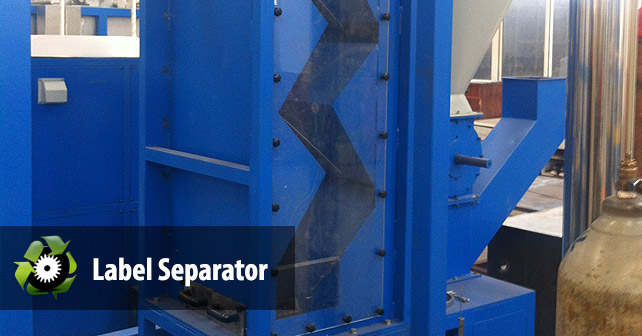
Description
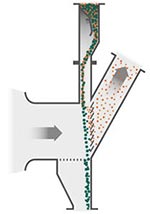 The label separator, sometimes referred to as the “air classifer” uses air pressure to separate heavier materials from lighter ones. As PET bottles are shredded whole, the material stream from the granulator will include a portion of PP / PE films from on the bottle labels. The label separator does an excellent job of separating PET flakes from plastic film labels.
How It Works
The mixture of PET flakes and PP/PE labels enter a sorting chamber containing a column of raising air. As the material mixes and is blown upwards, the PP / PE films (the lighter material) are blown upwards and are stored in a collection tank while the PET flakes (the heavier material) drop through the bottom and continue onto the next piece of machinery.
Models & Specifications
| Blower Motor: | 5.5 KW |
| Rotary Valve Motor: | 1.5 KW |
| Rotary Valve Diameter: | ⌀270mm |
| Rotary Valve Rotating Speed: |
50 RPM |
| Cyclone Separator Volume: | 600 L |
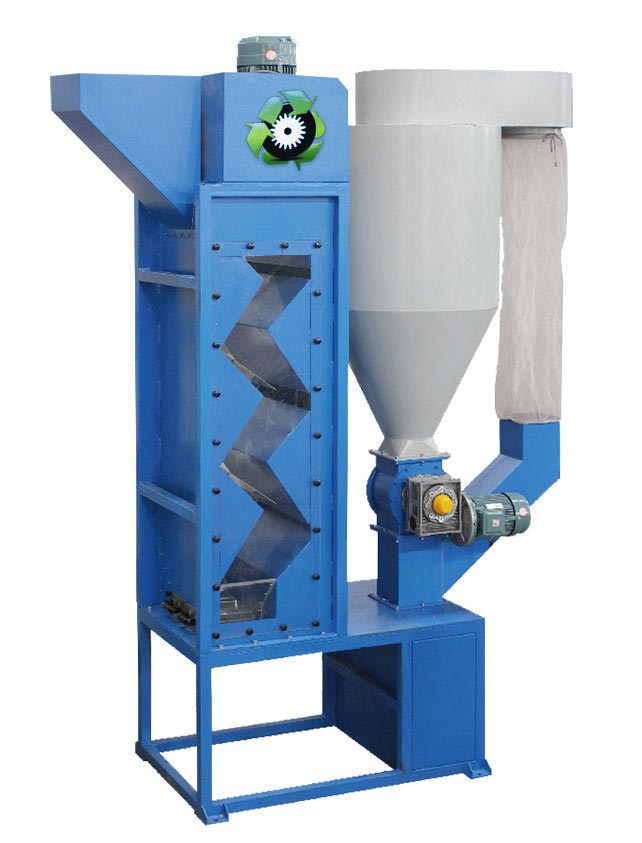
Additional Images
Place An Order
The general lead time for all single-piece, standard equipment orders is 30 days. For custom orders or complete washing lines, the lead time is between 60 – 90 days. The actual lead time will depend heavily on the complexity of the project as well as the amount of machinery we have in queue at the time of your order.
Contact us to discuss pricing and ordering details. Here is a brief summary of our ordering procedures.
Frequently Asked Questions
How does a label separator (air classifier) work?
The mixture of PET flakes and PP/PE label films enters a sorting chamber containing a column of rising air. As the material is blown upward, the lighter PP/PE films are carried up into a collection tank while the heavier PET flakes drop through the bottom and continue to the next machine. Air pressure — not water — does the separating, so the process adds no moisture to the flakes.
What materials can it separate?
It is designed to separate PET flakes from the PP/PE film labels that come off bottles during granulation. More generally, it splits any mixed stream where the components differ enough in weight and shape for an air column to carry one fraction up while the other falls — a principle related to density-based sorting.
What are the key specifications?
The unit uses a 5.5 kW blower motor and a 1.5 kW rotary valve motor. The rotary valve is ɰ270 mm in diameter and runs at 50 RPM, and the cyclone separator has a 600 L volume. These components are sized to handle the flake-and-film stream coming directly off a granulator.
Where does the label separator fit in a PET recycling line?
It sits right after granulation: PET bottles are shredded whole, so the granulator output contains both PET flakes and label films, and the separator splits them before washing. Removing the light films early keeps them out of the wash tanks, which improves cleaning efficiency and reduces contamination in the final flakes.
What maintenance does the machine require?
Typical upkeep covers the blower motor, the rotary valve (check the ɰ270 mm valve and its 50 RPM drive for wear), and the 600 L cyclone separator, which should be emptied and inspected regularly. Keeping the air path clear of film buildup maintains consistent separation performance.
How is air classification different from sink-float separation?
Both exploit physical differences between materials, but air classification uses a rising air column and suits light, flat films versus heavier flakes, while sink-float tanks use water density and suit PET versus floating PP/PE caps. Many PET lines use both: the air classifier for label films and a sink-float tank for cap material.