

Product Description
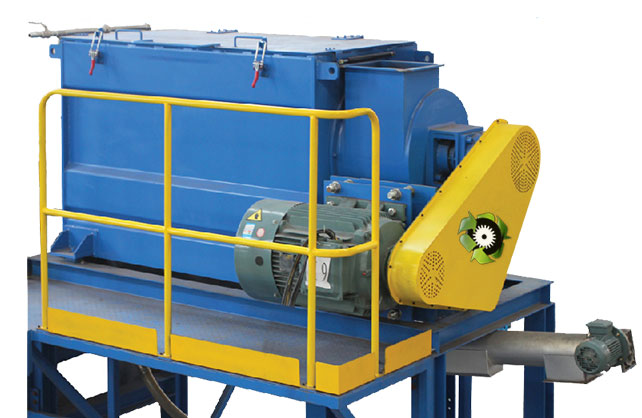
The first drying stage of our standard PP / PE film washing line, the dewatering machine can efficiently remove large portions of moisture from the PP / PE film directly after the washing process. Strategically placed after the sink / float separation tank, the dewatering machine uses centrifugal force to spin water outwards while the PP / PE films are contained within.
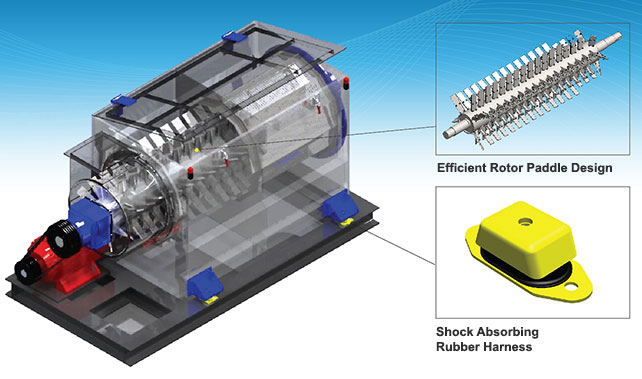
At the center of the dewatering machine is a long shaft mounted with many paddles spun to nearly 1,000 rotations per minute by an electric motor. Surrounding the paddled shaft is a mesh screen tunnel. As the slurry PP / PE film is fed into the vertical feeder, its instantly thrown outwards against a mesh screen that surrounds the shaft. Water passes through the mesh screen and is collected for recycling while the PP / PE film is continuously thrown and mixed around inside.
The PP / PE film, now partially dried, moves onto the next drying equipment, usually a thermal drying system. Generally, the PP / PE film leaving the dewatering machine will have moisture levels roughly around 20-30%.
Specifications
| Model #: | Motor Power: | Main Shaft Diameter: | Rotating Speed: | Capacity: |
| HXJ400 | 37KW | 400mm | 1400 RPM | 400 – 800 KG/H |
| HXJ550 | 45KW | 550mm | 1200 RPM | 600 – 1000 KG/H |
| HXJ750 | 55KW | 750mm | 1080 RPM | 1200 – 2000 KG/H |
More Images
Ordering
Our lead time for single pieces of equipment is 30 days from the signing of purchase contract. For custom orders such as complete washing lines, the lead time is between 60 – 90 days. Actual lead times will depend on the project’s complexity as well as our factory’s availability.
Contact us to discuss pricing and ordering details. Here is a brief summary of our ordering procedures.
Frequently Asked Questions
How does the dewatering machine work?
The machine uses centrifugal force: a long shaft mounted with many paddles spins at nearly 1,000 RPM inside a mesh screen tunnel. Slurry PP/PE film fed through the vertical feeder is thrown outward against the screen — water passes through the mesh and is collected for recycling while the film is continuously tossed and mixed inside. It is the first drying stage, placed right after the sink/float separation tank.
What moisture level does the dewatering machine achieve?
Film leaving the dewatering machine typically carries roughly 20–30% moisture. That is why it feeds the next drying stage — usually a thermal drying system — which brings moisture down to final specification. Our film washing moisture control guide explains how each stage contributes to the final result.
What models and capacities are available?
Three models cover 400 to 2,000 kg/h: the HXJ400 (37 KW, 1,400 RPM, 400–800 kg/h), HXJ550 (45 KW, 1,200 RPM, 600–1,000 kg/h), and HXJ750 (55 KW, 1,080 RPM, 1,200–2,000 kg/h). Choose based on your washing line throughput — the dewatering stage must keep pace with upstream washing to avoid bottlenecks.
Where does the dewatering machine fit in the washing line?
It sits immediately after the sink/float separation tank and before the thermal drying system. This position lets it strip the bulk of surface water mechanically — far cheaper than evaporating it — so the energy-intensive thermal dryer only handles the remaining 20–30% moisture.
What maintenance does the dewatering machine require?
The high-speed rotor puts the most stress on bearings and the mesh screen, so routine maintenance focuses on bearing condition, screen integrity, and paddle wear. Our centrifugal dryer maintenance tips cover the preventive routine, and the bearing replacement guide walks through a changeover step by step.
What is the lead time for ordering?
Single pieces of equipment ship within 30 days of signing the purchase contract. Custom orders such as complete washing lines take 60–90 days, depending on project complexity and factory availability. Contact us to discuss pricing and ordering details for your configuration.