

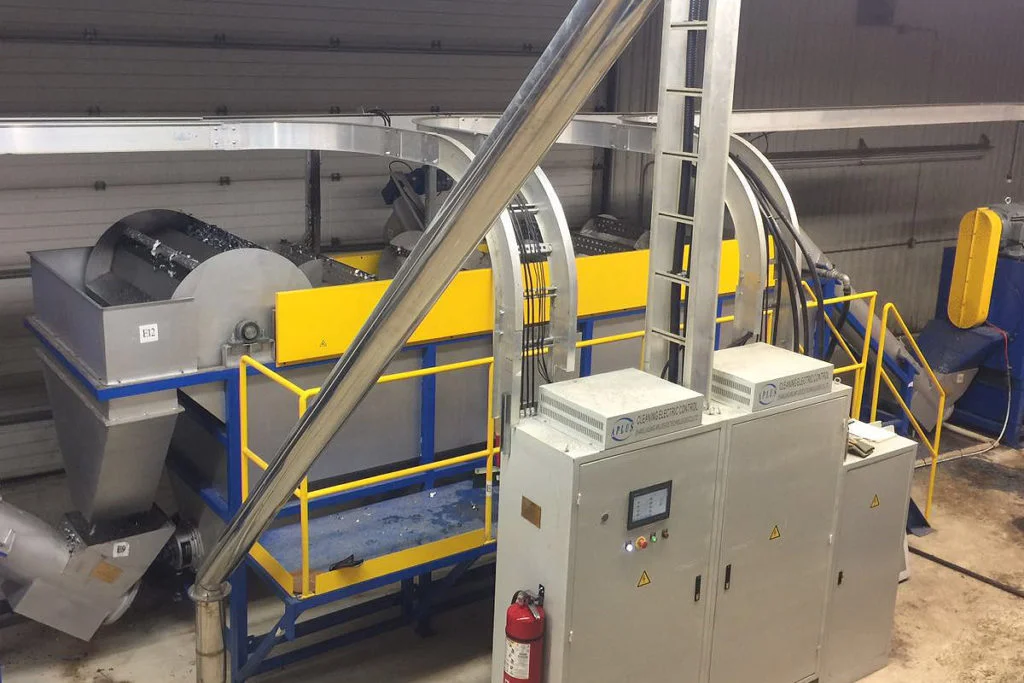
The whole line is used to clean the shredded PP/PE regrind, which consists of friction washer, floating tank, centrifugal dryer, squeezer, extruders and pellets cutting system. The explanations on some of the machines are as below:
WORKING PRINCIPLE
Friction Washer
The high speed friction washer is a recommended but not required piece of equipment in a plastic film washing line. At the core of a friction washer is a long, fast-rotating shaft mounted with many tilted panels or paddles. Surrounding this rotating shaft is a mesh screen tunnel used for dewatering. These are then encased within a retangular box where water jets and nozzles are mounted and directed at the mesh screen.
Sink float Tank
The sink float tank serves two purposes:
- Cleans: The plastic film is allowed to soak in a large tank of water loosening debris.
- Separation: The loosened debris and heavier contaminants will sink while the plastic films float. The top layer continues to the next step in the washing line while the sunk particles are removed.
Squeezer
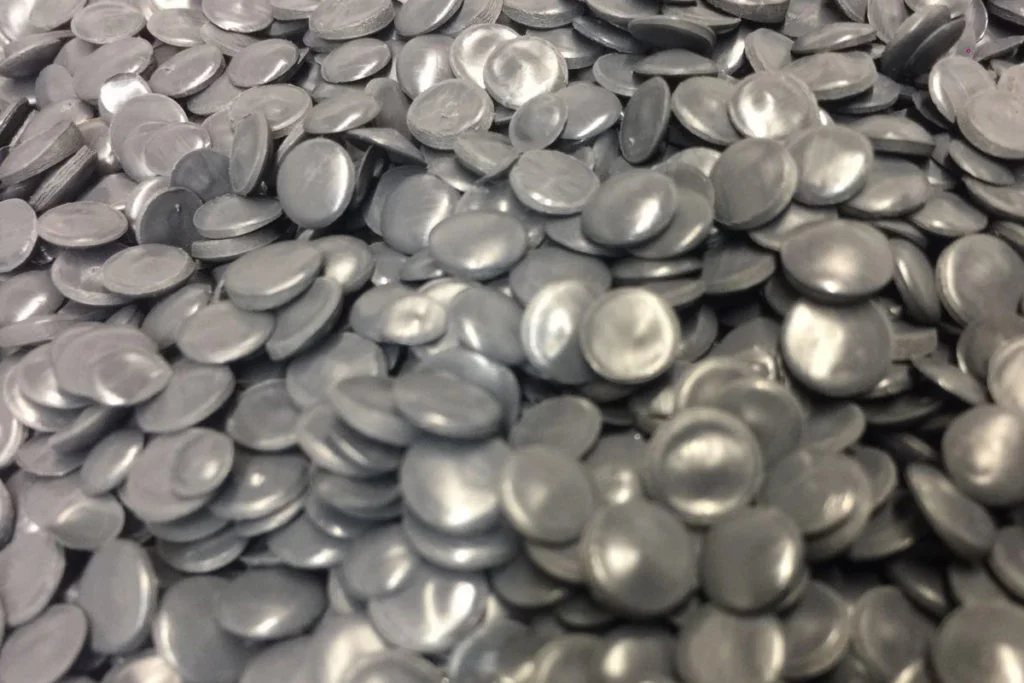
The last step of a plastic film washing line is the drying process. The wet plastic films need to be dried before it becomes extruded into plastic granules, the final step of the plastic film recycling process. In the extrusion process, plastic films are melted into a continuous flow of molten polyethylene plastic and squeezed through a die (similar to how spaghetti is made) and then cut into pellets or granules. If the plastic films are not dried properly before being extruded, the moisture become trapped within the molten plastic creating air bubbles in the final granules.
Here we use a squeezer to mechanically squeeze and heat the material. The material from squeezer is densified material .The resulting film is typically dry enough for extrusion, approximately 3%.
Here you can get a better understanding of typical machinery used in a standard plastic film regrind washing line. There is no proper way of setting up a film washing plant, however, careful consideration should be made based on the type of plastic film being recycled as well as the type and amount of contamination within. We are very glad to custom build the line for you
TECHNICAL SPECIFICATIONS
| Input Capacity | Size | Operator | Installation Power |
|---|---|---|---|
| 500kg/hr | 45m*15m*6m | 3-4 | 499KW |
| 1000kg/hr | 50m*15m*6m | 3-5 | 599KW |
*Larger, more powerful models available based on your request.
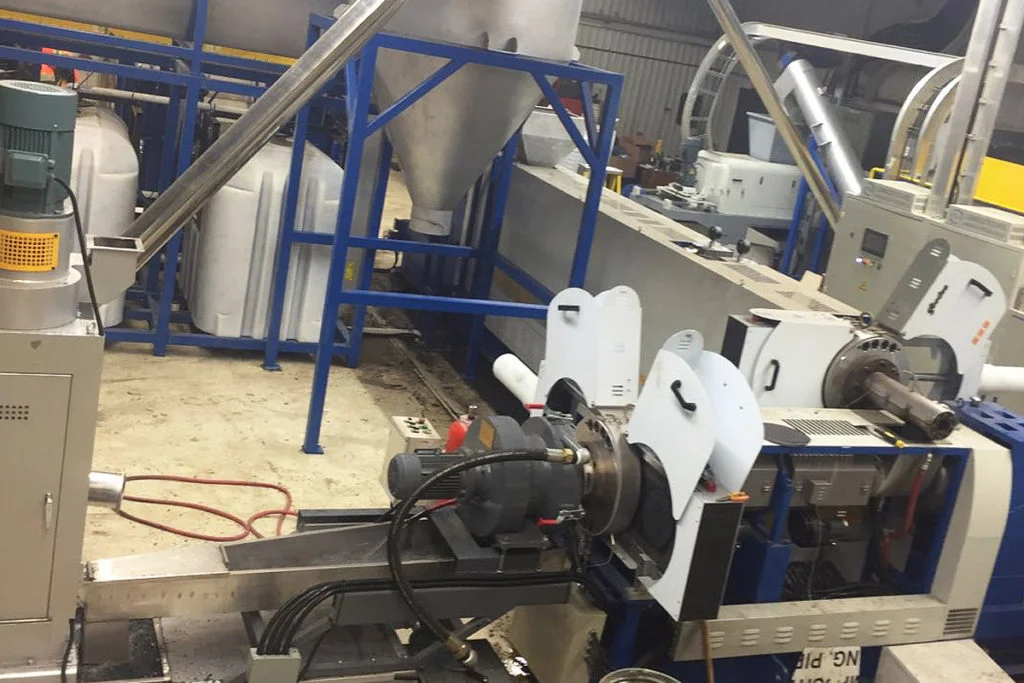
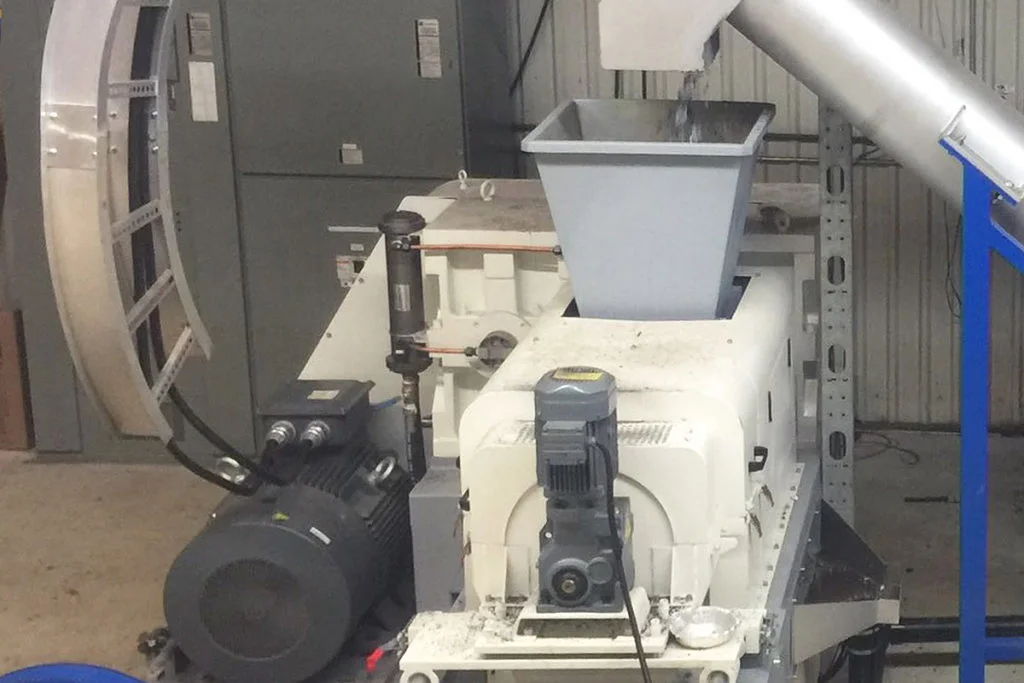
ADDITIONAL IMAGES
QUOTATION
WARRANTY & INSTALLATION
All recycling machinery comes with a 1 year limited warranty.
We offer installation packages where our engineers travel to your facility to guide your through the installation process the. Routine maintenance teams and operations consultants can also be arranged to ensure your PET recycling plant runs smoothly year and year.
INQUIRIES
To get the latest prices and lead times, send us a message using the form below.
Frequently Asked Questions
What does this regrind recycling line process and produce?
The line takes shredded PP/PE regrind — pre-cut film material — and cleans, dries, and pelletizes it into finished plastic granules. The train includes a friction washer, floating tank, centrifugal dryer, squeezer, extruders, and a pellet cutting system. Output is clean, dry pellets ready for extrusion or injection molding applications, turning film waste into a sellable recycled product.
Which machines are included in the line?
The standard configuration covers a high-speed friction washer for intensive scrubbing, a sink-float tank for soaking and density separation, a centrifugal dryer for mechanical dewatering, a squeezer for final drying and densifying, plus extruders and a pellet cutting system for granule production. Because there is no single proper way to set up a film washing plant, the configuration is customized to your film type and contamination level.
Why must film be dried to around 3% before extrusion?
If wet film enters the extruder, moisture becomes trapped in the molten plastic and forms air bubbles in the final granules — weakening them and causing defects in downstream products. The squeezer mechanically squeezes and heats the material to approximately 3% moisture, which is typically dry enough for stable extrusion. Proper moisture control during film washing is therefore critical to pellet quality.
What capacities and utilities are available?
Standard lines run at 500 kg/hr (45 m × 15 m × 6 m footprint, 3–4 operators, 499 kW installed power) and 1,000 kg/hr (50 m × 15 m × 6 m, 3–5 operators, 599 kW). Larger, more powerful models are available on request, and CE certification is available. Your quotation will detail the exact power, water, and space requirements for the customized configuration.
Can the line be customized for my film type?
Yes — careful consideration is given to the type of plastic film being recycled and the type and amount of contamination within. Film thickness, dirt load, label content, and available plant space all shape the final equipment selection and layout. The engineering team custom-builds the line so washing intensity, drying capacity, and extrusion setup match your specific material stream.
What installation support and warranty are included?
All recycling machinery comes with a 1-year limited warranty. Installation packages include engineers traveling to your facility to guide the installation process, and routine maintenance teams and operations consultants can be arranged to keep the line running smoothly year after year. Detailed operation instructions and a recommended spare-parts list are provided at purchase.